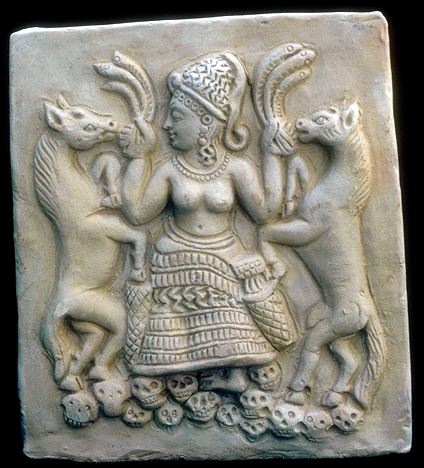
on religion "female"
It is well known in ancient times, near the Mediterranean peoples, were widespread fertility cults and the cycles of nature. These cults had as the central figure Magna Mater (Great Mother), it was revered because the land would bring plenty of fruits and was conducive for pregnancy in women. It was obviously religions "female", which is also amply demonstrated by the symbols that were used (think of the many statues depicting the so-called "Venus").
I think it would fall into error, however, whether these cults were regarded as the oldest or if you think of them as rites of "superior." On the contrary, it is more likely that they were diverted cults, which is closer to idolatry than real spirituality. The very fact that they worshiped the forces related to land (which in some aseptti has a "femmilile") is a confirmation of the fact that these cults were actually a little "blue", another confirmation is to be found by seeing how these goddesses be construed to require an abundance much more "material" and "spiritual."
According to a certain vision of "historical" (perhaps a little "academic"), these cults were popular mainly among the indigenous tribes Mediterranean, and were later replaced by religions (above) of the Indo-Europeans, once they are settled in the Mediterranean basin. The fact that the Indo-European peoples they subjugated the local population is actually fairly common ground: the most illuminating historical example is given by the submission of the Helots (Greek population "native") by the Spartans (who were Dorians, and therefore Indo-European) and from that moment on, the Helots would form the class servile, with the task of cultivating the land for the nobility of Sparta.
Regarding religion, the question is perhaps a bit 'more complex. According to the theory to which I referred a moment ago, the Indo-Europeans (who came from the north) in the Mediterranean brought their religious beliefs, and there would be a confirmation of this in the myth mentioned by Plutarch, it is said that eagles departed "from the end the earth "and came up
in Greece.
" [...] There is a story which tells that the eagles (or Swan) are parties from the extreme limits of the earth and direct in its center, they found themselves in the same place, at Pito, where the 'navel' "
Plutarch, Dialogues Delphic
L '" navel "spoken of here is the Omphalos of Delphi, the Greeks considered the center of the world and having a great religious importance. The eagle, on the other hand, is an animal "Olympics" for excellence, and was considered sacred to Zeus.
The interpretation of this myth tend to say then that there was a descent from the north both peoples and their religion, the latter always although it was still higher pagan cults "native". no coincidence that these people gave in later life to civilization with a structure "patriarchal", as befits any civilization really traditional (it is suspected that the earlier peoples were instead a structure "matriarchal").
When did this "changing of the guard, however, the female cults did not disappear entirely. Sometimes religion is integrated into the "official" (as in the case of the goddess Demeter, whose name seems to mean just "mother earth"), other times survived through the centuries, in a "parallel" and also hidden than Religions "orthodox". This is, for example, the case of "Sophia" of the Gnostic sects, according to the members of these current diverted, was even part of the trinity "in place" of the Holy Spirit. Sophia was also an "eon" leading "knowledge" (gnosis) and the "wisdom" (sophia, in fact) with which the man could escape from the dominion of God (which the Gnostics saw it as a demiurge "oppressive ").
In the Bible, the worship of these goddesses are particularly despised: they are equivalent to idolatry or even worship of demons. In particular, in the Old Testament, there are some references to the Mesopotamian goddess Astarte, whose worship is severely condemned as blasphemous.
(This goddess is also known as Ashtar
, Astaroth, Astartu, is associated with Venus in its lower aspects, not least because his cult was linked to the practice of "sacred prostitution"-even this practice is clearly condemned by the Bible,
in Deuteronomy 23, 18 - It is curious to note that one of the idols of the new age is an "alien" named
Ashtar Sheran. It is, in my opinion, yet another confirmation of the nature literally "satanic" of this pseudo- religion ... if there were no confirmations enough).
Nowadays it seems that these female cults are re-emerging, although seemingly different forms. On the one hand, there are so many "fanatics of the New Age" characterized by the waiting time of "women's spirituality" Age of Aquarius. Among them there are those who also speaks of "new aeon", using a terminology that derives mostly from Gnosticism, there is also the speaker of the return of humanity to a "kind of matriarchal society." On the other there are many "movements" that environmentalists and conservationists, under a form of doing good, hiding the pseudo-religion where nature is revered as a deity. Among other things, analyzing all these movements, you notice how they are characterized by the great importance given to "sentimentality." We must consider that sentimentality is something that is well below the reason, although some believe that it is something higher .. or even think that is something to "enhance".
A little 'passing, I add also that these environmental and neo-pagan religions often incite "vegetarian". I think it, especially when considered in its most extreme forms, conceals something very dangerous. It is certainly clear that this vegetarian food the "sentimentality" toward animals and nature, it is interesting to note, however, as in the past, who was welcomed into a community Cathar
should promise not to kill animals, not eating meat, and generally come from animal foods (milk, cheese, eggs etc.).. And the Cathars, the doctrinal point of view, it was not instill a form of Gnosticism.
-----------